The basics of photography: Aperture, Shutter Speed, and ISO
- Uncategorized
- 17 October,2023
To take a good photo, you need to consider three factors: aperture, shutter speed, and ISO. This is also known as the exposure triangle. These factors determine how your photo will ultimately look. This blog will explain exactly how to work with them.
What is an aperture?
The aperture can be seen as the camera’s eye. It regulates light and determines the depth of field. An aperture is an adjustable opening in the camera lens, consisting of blades or leaves. By opening and closing these blades, you can control the amount of light that falls on the sensor. The aperture is indicated on your camera as F-stops, such as F/2.8, F/9, F/22. This number represents the size of the lens opening. The larger the opening, the more light enters. By adjusting the f-stop, you can control not only the light but also the depth of field. This is often a powerful tool to enhance your photo.
– Small f-stop (e.g., f/2.8): This means a wide-open aperture. It lets in a lot of light and creates a shallow depth of field (background blur), which is ideal for portraits or subjects where you want to blur the background.
– Large f-stop (e.g., f/22): This means a small aperture. It lets in less light and creates a deep depth of field, making both the subject and the background sharp. This is useful for landscape photography.
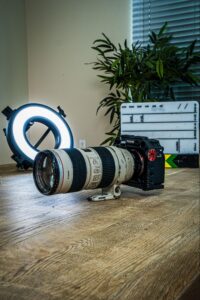
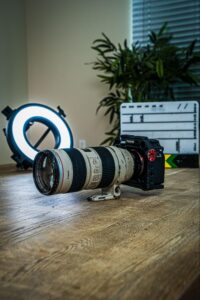
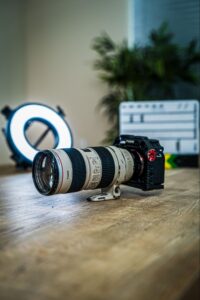
Understanding aperture allows you to find the right balance between sharpness and background blur in your photos. The images below clearly show how depth of field is regulated by the f-number.
F22 F9 F2.8
What is shutter speed?
Shutter speed allows you to freeze a moment or capture motion. Shutter speed refers to the time the camera’s shutter is open to let light hit the sensor. Shutter speed is measured in seconds or fractions of a second, such as 1/1000, 1/250, 1/30, and so on.
Shutter speed has two important effects on your photos:
– Exposure: A fast shutter speed (1/1000) results in well-exposed photos in bright conditions, while a slow shutter speed (1/30) allows more light in, ideal for low-light situations.
– Motion blur: A fast shutter speed freezes motion for sharp action shots, while a slow shutter speed blurs motion for artistic effects like flowing water or light trails.
Without realizing it, our own vibrations and movements affect our images. To prevent this, you can use a tripod. If you want to shoot handheld, follow this rule: use a shutter speed of no longer than 1/focal length of your lens (e.g., 1/50 second for a 50mm lens) for sharp results.
Slow shutter speed Fast shutter speed


What is ISO?
ISO determines how sensitive your camera’s sensor is to light. ISO values range from 100-6400, with the maximum value varying by camera.
ISO settings allow you to adapt to different lighting conditions while maintaining the quality of your photos. A low ISO requires more light than a high ISO. Use a low ISO in sufficient light, such as during the day. In low-light conditions, like in the evening, you can still capture good photos with a high ISO, but this can introduce noise. Therefore, it’s best to keep the ISO value as low as possible to maintain the best photo quality.
ISO 200 ISO 10.000


The secret to great photography lies in finding the right balance between aperture, shutter speed, and ISO. This requires practice and an understanding of how these three elements interact with each other. Therefore, experiment with different combinations and learn how to adjust them to the specific conditions in which you’re shooting.
If you can’t figure it out on your own, you can also leave it to experts. At Caribbean Legacy, we understand that capturing the perfect moment requires choosing the right settings. Additionally, successfully promoting your business also requires expertise and precision. Let us, as professionals, assist you in taking your business to new heights with targeted marketing strategies and creative approaches, just as an experienced photographer masters the exposure triangle. Together, we’ll work on creating the perfect image for your business.
- [addtoany]